
You Can Rank #1 on Google and Still Not Exist When Someone Asks AI
SEO gets you ranked. AEO gets you into the answer box. GEO gets you recommended — and it’s the only one of the three measured by whether a machine says your name out loud.
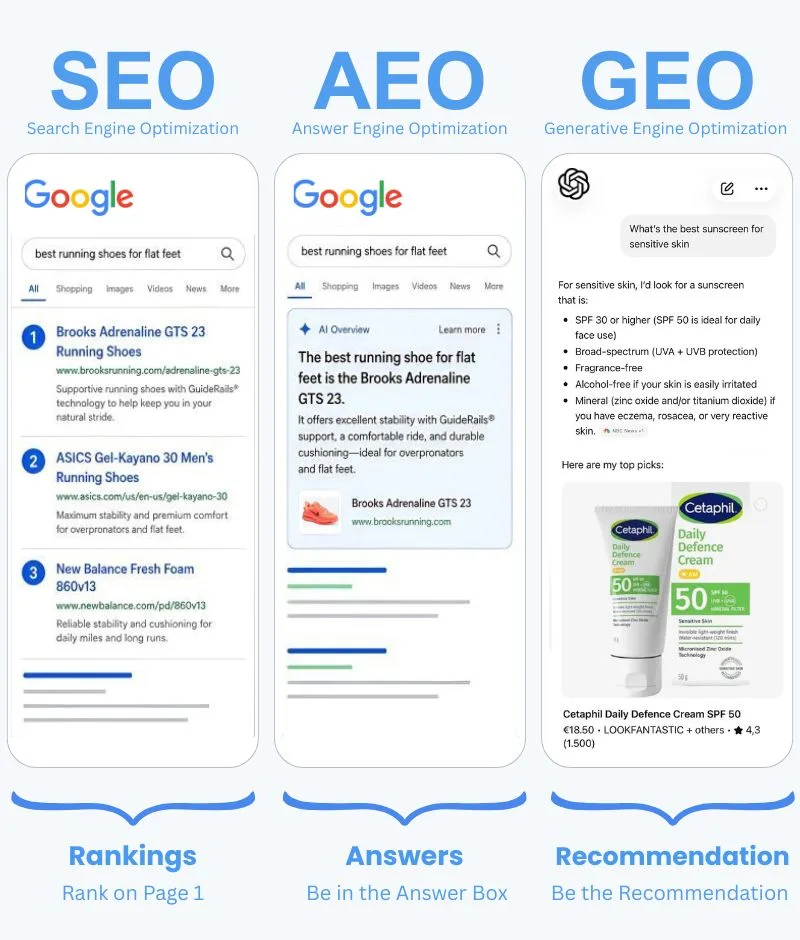
You’ve probably seen the three-column version of this by now. Mine included:
- SEO → Rankings. Be on page one.
- AEO → Answers. Be in the answer box.
- GEO → Recommendations. Be the brand the AI names.
It’s a clean way to see the shift. It’s also where most people stop — they nod, screenshot it, and file it under “things to get to eventually.” Usually right next to a resolution to do all three.
So let me give you the part the graphic can’t fit, because it’s the part that actually changes what you do on Monday.
Here it is: a business can sit at position one on Google, own the featured snippet, tick every technical SEO box — and still not come up at all when a buyer opens ChatGPT and asks for a recommendation. Not lower down. Not on “page two.” There is no page two. It simply isn’t in the answer.
That isn’t a glitch. It’s how the system is built. And once you understand why, “just do all three” stops sounding like strategy and starts sounding like the advice that keeps you invisible.
These aren't three rungs on a ladder. They're three different games.
The tidy way to read SEO → AEO → GEO is as a progression: master one, graduate to the next. That reading is wrong, and it’s expensive.
They’re not stages. They’re three separate games, each with its own win condition — and, crucially, each won in a different place.
- SEO is won on your page. Your URL, your links, your keywords compete for a slot on a list.
- AEO is still mostly won on your page — it’s your content made clean and quotable enough to be lifted into an answer box or an AI Overview.
- GEO is won almost entirely off your page. The model isn’t ranking your site against a competitor’s site. It’s assembling one answer out of everything the web says about your category, then deciding which two-to-seven brands are worth naming.
That last shift is the whole story. Google ranks pages. AI recommends brands. And a brand is not a page — it’s the accumulated impression of you scattered across sites you don’t own.
You can optimize a page you control. You cannot optimize your way onto a shortlist the machine builds out of everyone else’s pages. Different game. Different board.
The proof: ranking and recommendation have quietly divorced
This isn’t a hunch, and it’s worth showing the numbers because the gap is bigger than most people guess.
- A 2026 EMGI analysis of 150 SaaS companies found that 81% of the brands ChatGPT recommended did not rank in Google’s top 10 for the same query.
- The overlap between the pages that top Google and the sources AI engines actually cite has, by 5W Research’s measure, collapsed from roughly 70% to under 20%. Ahrefs put it sharper still — only about 12% of URLs cited inside AI answers also rank in Google’s top 10 for that prompt.
- Meanwhile AI isn’t a side channel anymore. BrightEdge data from early 2026 has Google AI Overviews triggering on roughly 48% of all searches — and when that summary appears, the vast majority of users never scroll to the blue links underneath.
Read those together and the uncomfortable conclusion is this: you can win the game you’ve been measuring and lose the one that’s quietly taken over the buyer’s first move.
Why the two systems reward completely different things
Google, at its core, rewards authority you own — your link profile, your on-page signals, your click behaviour. Single-source strength. It’s a system that asks, “how strong is this page?”
AI engines reward something researchers have started calling consensus signal — corroborated information across multiple independent sources that agree about who you are and what you’re good at. It’s a system that asks, “does the wider web vouch for this brand, consistently, in ways I can verify?”
That’s the pivot in one line: SEO is about your own authority. GEO is about other people’s testimony.
If the only place your claim exists is your own website, Google can still rank you. An AI model, hunting for independent corroboration, finds nothing to stand on — and leaves you out. There’s a solar company that makes the point better than any statistic: ranked #1 in its market, absent from ChatGPT’s recommendations entirely. The three brands the model did name weren’t better-optimized. They had the PR coverage, the Reddit threads, the review volume, the third-party citations. The web talked about them. It didn’t talk about the market leader. So to the model, the market leader wasn’t the market leader.
The layer almost nobody explains: the engines don't agree with each other
Here’s where “GEO” as a single target falls apart — and where the real work lives.
There isn’t one AI to optimize for. There are five, and they read the web through different pipes:
- ChatGPT is the outlier that matters most by usage. Its live pipeline leans on Bing plus OpenAI’s own index — and roughly 70% of what it cites ranks nowhere in Google’s or Bing’s top 10. Your Google rank barely helps you here. Brand mentions across the web do.
- Perplexity pulls the large majority of its citations from content that already ranks well on Google. Strong SEO carries over better here than anywhere else.
- Gemini sits inside Google’s ecosystem, leaning on Google’s crawlers and Knowledge Graph — so entity consistency and Google visibility both pull weight.
- Google AI Overviews draw heavily from Google’s own top results, but rarely hand out a clean brand recommendation at all.
- Claude is the most conservative of the lot. It wants stronger evidence before it’ll name you, which makes it a useful forcing function: build to Claude’s bar and you tend to clear everyone else’s along the way.
So the honest version of GEO isn’t “get recommended by AI.” It’s “get recommended across five engines that weight your Google ranking anywhere from decisive to nearly irrelevant.” Anyone selling you a single lever for that is selling you a screenshot.
One more nuance worth keeping, because the hype flattens it: brand mentions don’t move every engine equally. Ahrefs’ correlation work found branded web mentions strongly tied to appearance in Google’s AI Overviews, but only weakly tied in Perplexity and barely in ChatGPT. Mentions matter — they’re just not a universal cheat code. What does travel well: a large Surfer study across hundreds of thousands of cited URLs found that brand mentions inside blog content correlated with recommendation strength more than mentions anywhere else. Being written about, in substance, on pages an engine trusts, is the closest thing to a through-line.
Why "you need all three" is quietly the most dangerous line on the slide
I put “you need all 3” on my own graphic. I stand by it. But left there, unqualified, it does something subtle and damaging: it implies equal effort and a comfortable sequence, when the leverage has moved and the scoreboard has changed.
The trap is measurement. GEO does not show up in your rank tracker. It doesn’t show up in your position reports or your Search Console clicks. If you’re only watching the instruments built for the old game, you can be steadily disappearing from AI answers while every dashboard you own says you’re winning. That’s not a small blind spot. For a growing share of buyers — well over half now start product research inside an AI tool rather than a search bar — it’s the whole shopfront going dark while the lights inside still look on.
“Do all three” is only useful if you also change what you count. Recommendation rate. Share of voice across engines. Which brands the model names when someone asks your category question, and whether yours is one of them. None of that lives in a ranking.
So — the only question that actually matters
Rankings tell you where your page sits. They no longer tell you whether you get chosen.
The real question isn’t “am I ranking?” It’s the one I keep coming back to: when your ideal customer asks an AI to recommend someone in your category, does it say your name?
Most brands have never checked. It takes about ten minutes to find out. Open ChatGPT, Perplexity, and Google AI Mode. Ask each the question a buyer would actually ask — “best [your category] for [your customer]” — and read what comes back. Note who gets named. Note whether you’re in the shortlist, mentioned but not recommended, or simply absent.
Whatever you find is your real starting line. Not your ranking. Your recommendation.
Then the work begins where the game is actually played — off your own website, in the consensus the web builds about you. But you can’t fix a scoreboard you’ve never looked at.
So go look. Then come tell me what the machine said about you.